
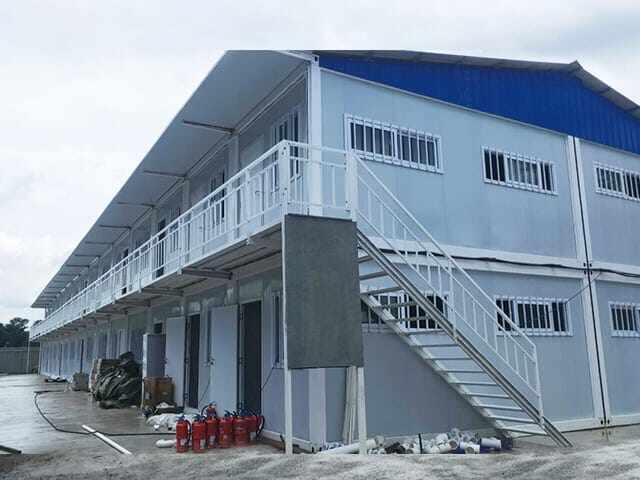
How Strong and Safe Are Prefab Container Houses in Typhoons?
Introduction
When a typhoon approaches, the first question on every homeowner's and project manager's mind is:Will my structure hold?
For prefab container homes, the answer isn't just "yes" — it's a definitive "yes, with proper engineering." Prefab containers are inherently strong, modular, and widely available globally. Studies confirm they offer high structural strength and can withstand severe wind and seismic loads.
Strength alone isn't enough. Let's examine exactly how strong container houses are, what makes them safe during typhoons, and what engineering measures ensure their survival.
Understanding Wind Resistance Levels
What Do the Numbers Mean?
Different container house designs provide varying levels of wind resistance:
Resistance Level | Wind Speed | Equivalent | Application |
|---|---|---|---|
Level 10 | ≤111.5 km/h | Standard | Basic applications |
Level 12 | 32.7 m/s | Typhoon-resistant | Moderate-risk areas |
Level 15 | 110 mph | 1.62 kN/m² pressure | High-risk regions |
Level 16+ | 150+ mph | Extreme | Custom-engineered solutions |
Some standard product designs meet basic load requirements at a wind pressure of 0.45 kN/m² (equivalent to Wind Level 10). For harsh environments with higher wind pressures, structural reinforcement is required.
The gold standard: Through structural calculations, upgraded container solutions can withstand typhoons ofLevel 12–16, fully meeting usage needs even in extreme weather. Engineering tests show the containers can withstand winds exceeding 150 mph — impressive given that most standard buildings begin to struggle at roughly half that speed.
Key Engineering Measures for Typhoon Resistance
1. Structural Reinforcement
Steel quality matters: The base material is high-strength weather-resistant steel. Upgraded features include:
Reinforced roof and floor support systems
Increased steel consumptionto improve overall rigidity and deformation resistance
Corner connections and inter-unit bracingDesigned to resist lateral forces, preventing tipping or unit separation.
Reinforced steel frameswith additional structural supports
The resultContainer houses are sturdier and more durable than traditional prefabricated homes, providing a solid foundation for wind resistance from the ground up.
2. Foundation Anchoring
A building is only as strong as its connection to the ground. During typhoons, uplift forces can rip structures from their foundations.
Bottom embedded component fixation solution:
Embedded parts are firmly welded to the container's bottom beams.
The container is securely anchored to the ground.
Thissignificantly reduces the risk of tipping over and displacementduring typhoons
For extreme conditions: Pre-embedded anchors in concrete foundations deliver superior hold-down strength, effectively resisting vertical uplift forces.
3. Impact-Resistant Components
Impact-resistant glassFor Windows
Hurricane shuttersor storm-resistant glazing
Secure connectionswith anchor bolts or concrete pads
4. Corrosion Protection
The Philippines' climate—high temperatures, heavy rainfall, and salt spray—creates risks beyond wind exposure.
Hot-dip galvanized steel structureis adapted for:
Effectively resists corrosion and moisture damage
Extend the lifespan of prefabricated homes
Lower long-term maintenance costs
5. Inter-Unit Connections
FFor multi-unit configurations, inter-unit connections are critical:
Corner connections must resist lateral forces
Bracing prevents stacked or side-by-side units from separating.
Structural analysis ensures all members are adequate.
Case Study: Container Housing Under Philippine Typhoon Conditions
The Philippines offers real-world validation of container house typhoon performance.
After Typhoon Haishen in 2024, a Philippines relief camp used container units for housing500 families within 72 hoursFactory-built shelters consistently meet all standards.
Academic research confirmsPrefab containers are a viable option for temporary or permanent housing for disaster victims due to their modularity, strength, and availability. Studies evaluating container housing in Quezon City and Leyte — a hot, humid, typhoon-prone region — have confirmed their structural viability.
Key findingContainer houses have become a transformative force in the Philippines' post-typhoon recovery, delivering rapid, cost-effective, durable, and sustainable shelter.
Are Container Homes Safer Than Conventional Buildings in Typhoons?
The evidence suggestsyes — when properly engineered.
Why Container Homes Often Outperform Traditional Construction:
Inherent steel strengthShipping containers are engineered to stack heavy loads and withstand rough ocean transit — built tough from the ground up.
Factory quality controlUnlike on-site construction, factory-built modules benefit from controlled environments and consistent quality standards.
Engineered connectionsEvery joint, anchor, and reinforcement is calculated for specific wind loads
Modular flexibilityUnits can be configured to distribute wind loads more effectively than irregular traditional structures.
The caveat: Not all container homes are built the same. Standard, unmodified containers may not withstand typhoons. Proper engineering—structural calculations, reinforcements, and foundation anchoring—is essential.
Key Features of a Typhoon-Resistant Container Home
For B2B buyers and project managers, here's your checklist:
Requirements | Verification Checklist |
|---|---|
Wind load calculation | Request structural calculation reports with kN/㎡ ratings |
Steel thickness | Minimum 0.3mm high-strength weather-resistant steel |
Foundation system | Embedded anchors or screw piles for uplift resistance |
Roof design | Sloped with drainage—no flat roofs that collect water |
Corrosion protection | Hot-dip galvanized or equivalent coating |
Window specifications | Impact-resistant glass and secure framing |
Certifications | CE, ISO, or local building code compliance |
Conclusion
Prefab container homesareStrong and safe during typhoons — when engineered correctly.
The inherent strength of steel shipping containers provides an excellent foundation for typhoon-resistant construction. However, this foundation must be supplemented with:
Structural reinforcementsfor roofs, floors, and inter-unit connections
Proper foundation anchoringto resist uplift forces
Impact-resistant componentsfor windows and openings
Corrosion protectionfor long-term durability in coastal environments
With these measures in place, container homes don't just withstand typhoons—they provide safe, reliable shelter when it's needed most.